Occupancy sensing · 360°

Lights that switch themselves.

Two ceiling PIR motion sensors — one surface-mount, one concealed — that turn the lighting on when someone walks in, hold it while they stay, and switch off after they leave. Up to 1200 W, wired like a switch.

How a PIR sensor works

PIR stands for passive infrared. The sensor transmits nothing — it watches the far-infrared heat that every person radiates, and reacts when that heat moves.

01

Everybody radiates

Warm bodies give off far-infrared radiation — a wavelength near 10 µm, far beyond the visible band. The sensor's pyroelectric element reads that heat. It emits nothing itself.

02

The dome slices the room

The faceted dome is a Fresnel lens array. Each facet focuses a different slice of the room onto the element, dividing the space into dozens of detection zones.

03

Movement is a changing signal

Walk from one zone into the next and the heat pattern on the element shifts. That change is what trips the sensor — which is why it reacts to a person moving, not to a warm room.

04

The relay does the rest

A relay switches mains to your luminaires. Motion keeps restarting the hold timer; the lux setting keeps everything off while daylight is already enough.

The two sensors

PIR Surface Sensor

EN-PIR-SM Surface mounted

Mounts on the ceiling surface — slab, grid tile or plaster — with two screws and no cutout. Hold time and daylight threshold set on the body, and an indicator LED confirms each trigger. The one for retrofits and exposed ceilings.
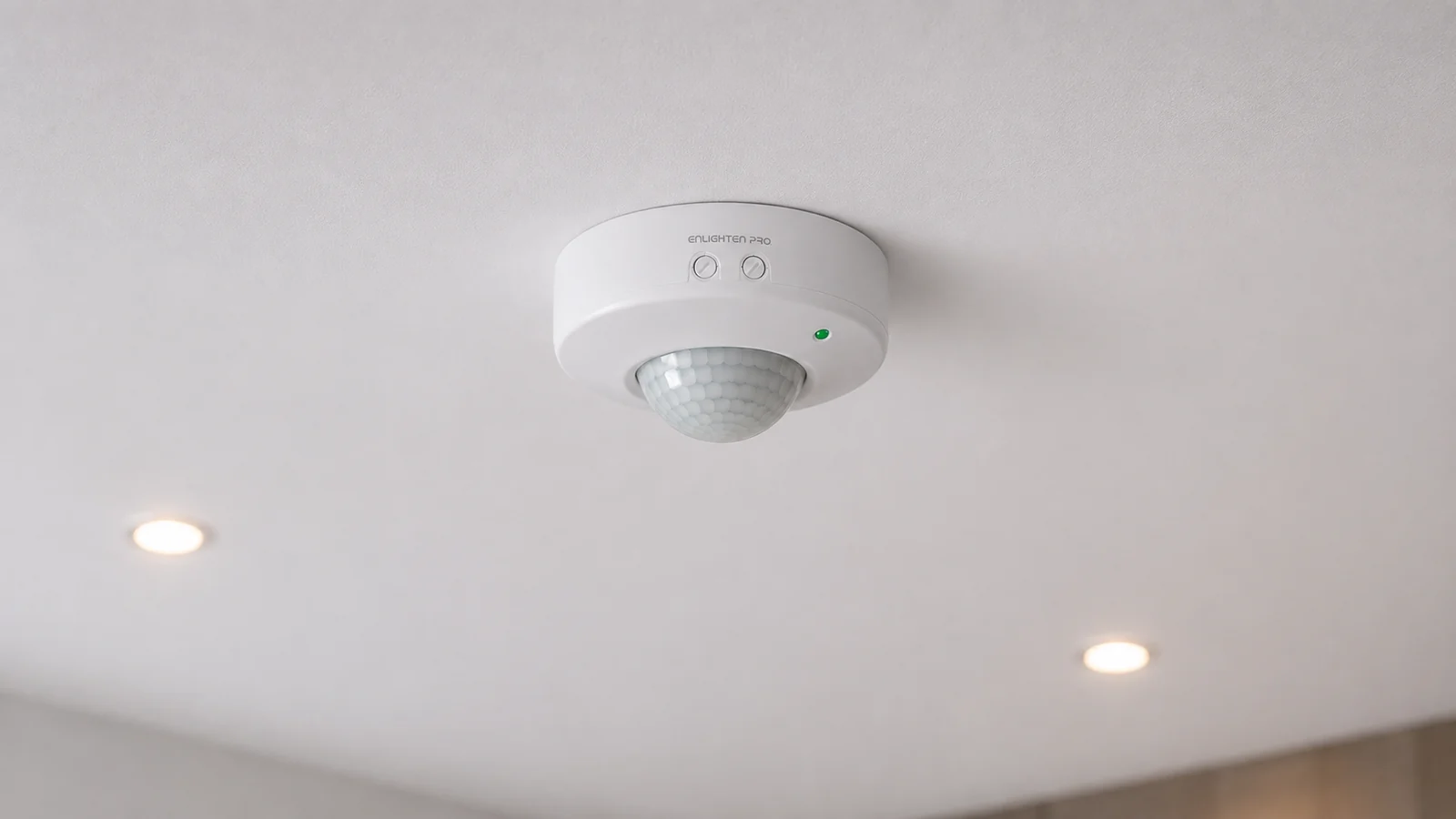
PIR Surface Sensor EN-PIR-SM mounted on a ceiling, body proud of the surface with the faceted dome facing down

Mounting

Surface, 2-screw

Size

Ø 110 × 57 mm

Detection

360° · 6 m max (<24 °C)

Coverage

10–12 m working diameter

Mounting height

2.2–4 m

Hold time

10 s – 7 min, adjustable

Light threshold

3–2000 lux, adjustable

Motion speed

0.6–1.5 m/s

Max load

1200 W @ 220–240 V
800 W @ 110–130 V

Supply

220–240 V AC · 50 Hz

Protection

IP20 · indoor

Finish

White
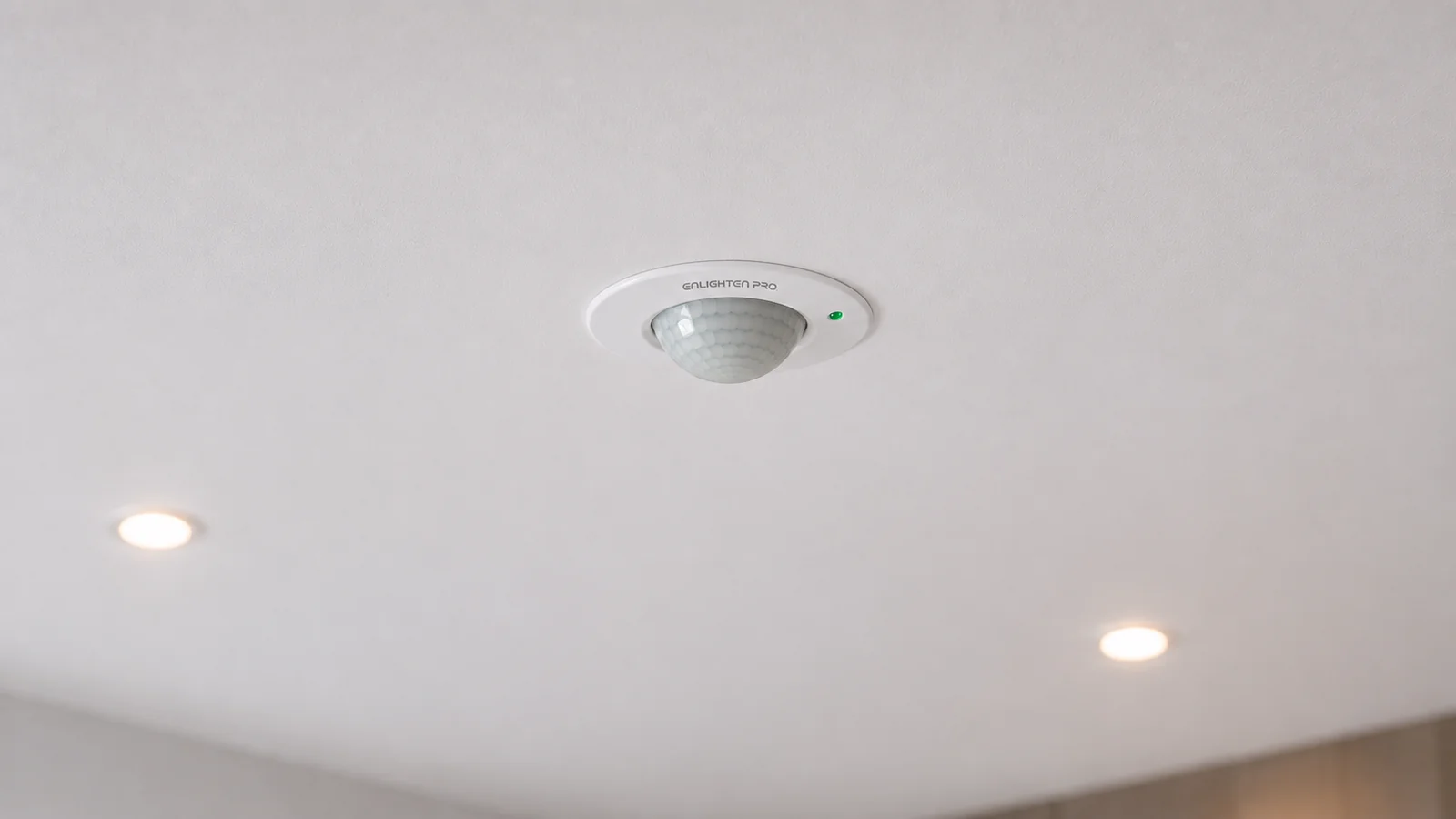
PIR Concealed Sensor

EN-PIR-CM Recessed · Ø 64 cutout

Recesses into a Ø 64 mm cutout — the hole a small downlight takes — leaving only the Ø 75 mm trim and the dome flush with the ceiling. Spring clips hold it in the tile. Hold time and threshold adjust on the unit.

PIR Concealed Sensor EN-PIR-CM recessed into a ceiling, only the trim ring and dome sitting flush with the plaster

Mounting

Recessed, spring clips

Cutout

Ø 64 mm (62–65 mm)

Size

Ø 75 × 55 mm

Detection

360° · 6 m max (<24 °C)

Mounting height

2.5–3.5 m

Hold time

10 s – 7 min, adjustable

Light threshold

3–2000 lux, adjustable

Motion speed

0.6–1.5 m/s

Max load

1200 W incandescent
300 W LED @ 220 V

Standby draw

0.5 W

Supply

100–240 V AC · 50/60 Hz

Protection

IP20 · indoor

Relay ratings are for incandescent / resistive loads unless marked LED. Switching LED fixtures, size to the LED figure and stay well inside it — LED drivers pull a brief inrush at switch-on.

Which one?

Surface — EN-PIR-SM

No false ceiling, exposed slab, or a finished room you'd rather not cut into. Screws on anywhere, and unscrews just as easily when it's time to service.

Concealed — EN-PIR-CM

False ceilings and clean interiors. Only the trim and dome show, sitting flush beside your downlights — it cuts in with a Ø 64 mm holesaw like any small spot.

Shared figures

Detection

360°
6 m max (<24 °C)

Hold time

10 s – 7 min
adjustable

Light threshold

3–2000 lux
adjustable

Switched load

1200 W max
relay output

Per-model figures — sizes, cutout, LED rating, standby draw — are with each sensor above.

Wired like a switch

L · Brown N · Blue Sensor PIR · 360° Switched live · Red Luminaire

Live and neutral go in; the sensor hands back a switched live to the luminaire, which completes on the same neutral. Any electrician who can wire a switch can wire this — no hub, no pairing, no app.

One sensor can switch a whole group of fixtures — a corridor of downlights, a strip run through its driver — as long as the total stays inside the load rating.

Where they go

Corridors, stairs and lobbies

Common areas nobody owns the switch for. The lights run only while someone is actually passing through.

Washrooms and changing rooms

Hands-free switching where nobody wants to touch a switch — set a longer hold time so it rides through the quiet minutes.

Stores, basements and parking

The rooms where lights burn all night unnoticed. A sensor pays for itself here first.

Adding sensing to a project?

Tell us the rooms and the fixtures — we'll come back with placement, quantities and the right hold settings.

WhatsApp us Browse the catalogue